Cynthia went from a literature grad program to explaining C/C++ runtime error detection tools in about three weeks. Since then, she has co-authored six books, with the latest one an ambitious 6-month “weekend project”. That makes her the perfect guest for the show. I asked her all the questions that make writing so unique: how she ended up writing so many books, how she keeps going, what her writing process is, where her ideas come from, and much more.
The interview is structured around a big part of how to write books, getting ideas with note-taking, her editing process of sitting on it overnight, and how she uses AI for writing (or doesn’t). There are so many insights, here just three of them:
“Readers want to read your authentic words, not soulless grammatical perfection”
“I feel like thinking through an idea doesn’t ‘count’ unless it’s written down somewhere”
“Please don’t let LLMs homogenize it”
This is the second episode of «Show your Workflow», a written podcast format that tries to convey the craft of writing behind the writer, and I couldn’t be happier to have someone like Cynthia, who is so experienced. I hope you enjoy it as much as I did.
Firstly, who is Cynthia Dunlop?
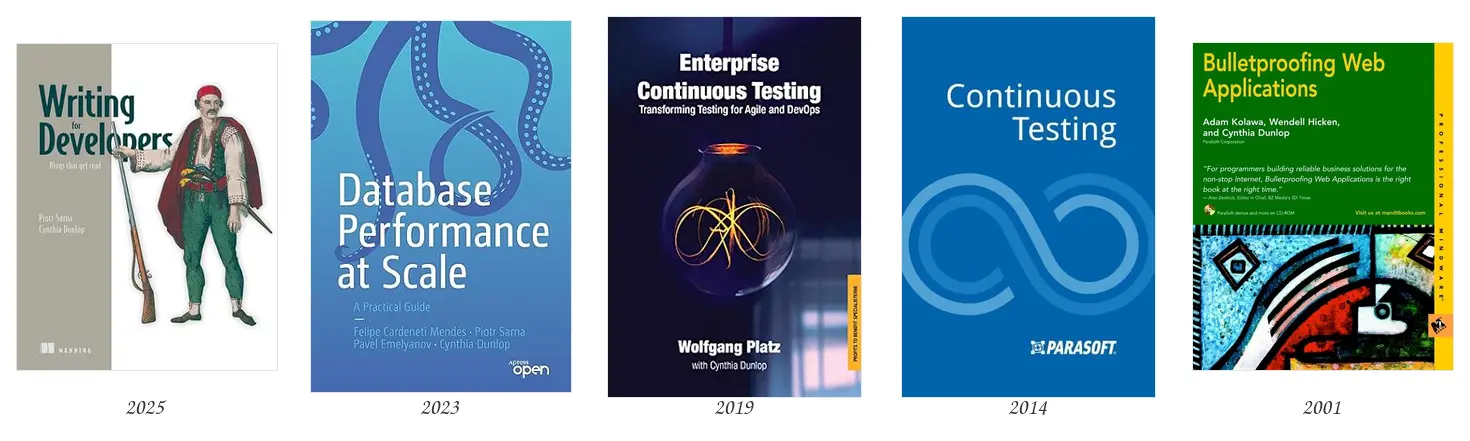
Cynthia Dunlop is Senior Director of Content Strategy at ScyllaDB. She has been writing professionally for decades now: she started as a course notetaker at UCLA (undergrad), studied literature and taught writing at Washington State University, then pivoted to tech writing at the dev tools company Parasoft. There, she led technical writing and wrote her first books with the developers and founder. Then came Tricentis as Director of Strategic Content (continuous testing books), ScyllaDB (database performance), and finally Writing for Developers with Piotr Sarna. In total, an impressive track record of 5 books (+1 ghostwritten), from newest to oldest:
To start, I wanted to know how Cynthia began her writing career. We know a little from the introduction, but here’s her answer to “How did you get into writing?” and “What was your first interaction with writing? And how did you end up starting to write online?”
My first paid writing gig was as a course notetaker for UCLA, well before the days of Granola, etc. I got paid to attend a variety of interesting classes (Engineering, Law, Literature, Arts…), write structured notes in real time (with pen and paper!), and hand them off the minute the class ended.
Next, I taught freshman writing for a couple of years at Washington State University. I went there to study literature in graduate school, but I was surprised by how much I enjoyed the writing aspect. I also ended up doing some tech writing coursework as part of that grad program.
After that, I ended up pivoting from literature to tech writing. I went from being in a literature grad program to explaining C/C++ runtime error detection tools in a matter of ~3 weeks. My first job was at a dev tools startup, where I ended up writing articles and books with the developers and founder as well as leading tech writing.
The idea of the book was to bring our two very different perspectives and sets of experiences together to create a fun guide that would ultimately give us all more – and better – engineering blog posts to read. We really wanted to help reluctant writers get started, and also share tips that would benefit writers of all experience levels.
We had collaborated on a book and blog posts before, and enjoyed chatting about writing as well as critiquing blog posts we came across. Honestly, the idea just popped into my head one morning when I was up super early for an event and my mind was probably wandering more than it should have been. “Oh, we should write a book about writing blog posts. And it should recognize that different types of blog posts should be approached quite differently”. I texted the idea to Sarna, he agreed within the minute, and we started fleshing out an outline.
That was it. We didn’t decide to write a book and then brainstorm ideas. We didn’t even really want to write a book (books are a lot of work, especially on top of full-time jobs). But we wanted to write that book…so we made it happen. It was a pure “weekend project” that sprawled into 4 am starts on my end and some late nights on Sarna’s. We wrote it all within 6 months, all totally async. Much caffeine was consumed in the process.
How She Ended Up Writing So Many Books
I asked Cynthia why she has written so many books, or how she ended up in this position.
She started early, when CD-ROMs still existed. It was the heyday of technical book writing when she wrote Bulletproofing Web Applications.
It was when she was working at a bootstrapped startup that competed with the likes of HP (Hewlett-Packard) and IBM. Getting the company’s technical experts published in physical magazines2 was an affordable (free!) way to get developers’ attention. The company really prioritized reading and writing, their publications got attention, and they were asked to write a book.
Then the others followed. She said: “After you write a book for a company in their employment, every other company wants you to write one for them too”. That’s one reason she managed to write so many, as she got paid for part of her time to do so. E.g., at ScyllaDB, she spent part of her time on the clock writing Database Performance at Scale, and the company supported it.
The Hardest Part: Printing, Not Writing
Let’s spend some time on book writing, which Cynthia does so well. I asked her what the hardest part of writing a book is, and whether all books were equally hard to write.
And to my surprise, it was not the writing. That was fun for her, especially when the ideas were flowing. It was the actual printing when self-publishing. “It was painful”, she said. Once, she had a conference book signing in Vienna, and getting the first prints on time was a challenge: the rather large order paid with a US credit card was flagged as fraud 😉. Luckily, the books arrived 12 hours before the event, just in time.
Also, Amazon’s printing happens in different regions, meaning the quality of the finished book looks different depending on which printing house you get.
Learnings from Publishing
If your primary goal is to make money, don’t go with a publisher.
If your primary goal is to profit from what you write, you will likely be better off self-publishing. But if you want to reach more readers, strongly consider working with a publisher – and realize that all publishers are not created equal. She shared that there’s a huge discrepancy of support across publishers, so prospective authors should do their homework before deciding. Also, consider that the publisher will own the copyright. If you want your book to be open access (free to read, share, and reprint), you have to pay the publisher for that privilege, so she was happy that her employer paid for that for Database Performance at Scale.
Also, Cynthia was lucky early on to work with an experienced team of editors from IDG (International Data Group, the original publisher of the “For Dummies” books), with their more casual style, where she learned a lot.
Book Publishers
Each publisher has its strengths and a different focus. Some can put you in touch with industry experts, others give you a lot of freedom, some offer lots of flexibility in author compensation models, etc.
Cynthia writes more about book publishers in her book on ‘Writing for Developers’:
Apress: Covers “a wide range of technologies, from big data solutions to Microsoft or Apple development to security to Linux administration to electronics and Raspberry Pi”.
No Starch Press: Technology books with a focus on “open source, security, hacking, programming, alternative operating systems, LEGO®, science, and math”.
Wiley: Covers a wide range of topics across various academic and professional disciplines, including computer science.
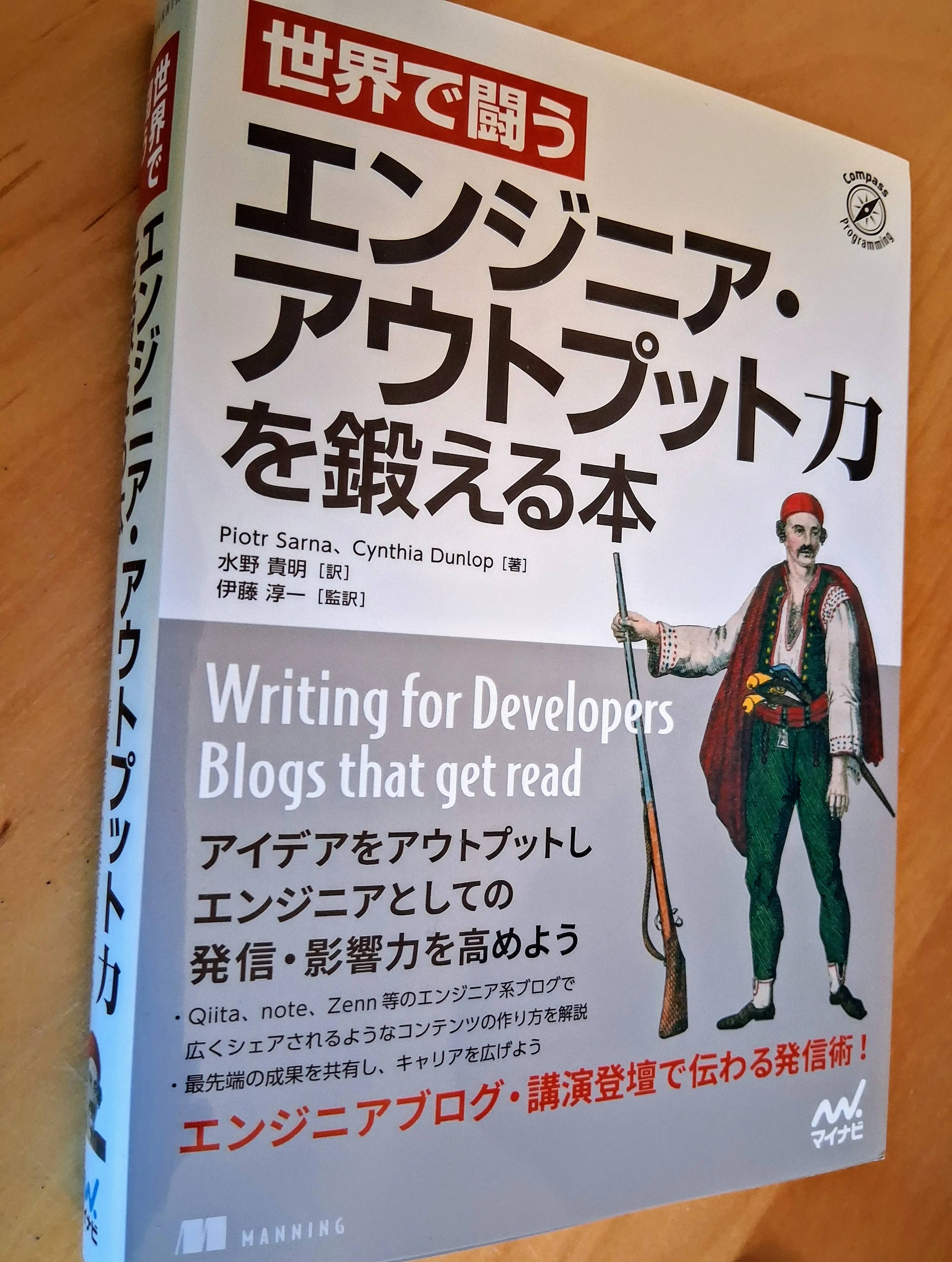
She really enjoyed writing with Manning, which they choose for ‘Writing for Developers’. It was fun to write. Manning also enabled all the different translations, and they got feedback on the proposal – and the manuscript – from legendary bloggers they didn’t expect, like Scott Hanselman and Jeff Atwood. Also, their book team convinced Eric Lippert, a veteran software engineer, compiler specialist, and programming language designer who worked at Microsoft from 1996 to 2012, to serve as the book’s technical editor, where he read and reviewed every paragraph of every chapter as it was written. This gave them invaluable feedback you can’t just get around the corner.
E.g., check out this careful and beautiful translation in Japanese (there’s another one in Korean) | Shared on X by Cynthia
How to Keep a Book Relevant
A major challenge is to write a book that is not outdated tomorrow or the day it’s out, especially since there’s usually a delay between writing and printing. How do you deal with that?, I asked Cynthia. She said, “You have to factor that in from the start”. She takes a step back and focuses on principles that hold, while being aware that some of the supporting details mentioned will eventually show their age (e.g., noting that certain AI revision attempts were made by Claude 3.5 Sonnet).
Getting Ideas and Taking Notes
Looking beyond writing a book, at taking notes in general and where ideas come from, I asked Cynthia how she comes up with ideas for her next blog post, and what the key medium/idea that carries the whole post is.
I have a massive backlog of ideas of things to write, both personally and for my actual job. They’re mostly generated from reading and listening, then stewing on what would be interesting ways to advance the discussions. I’ll usually store a vague challenge, need, or question in the back of my head for a while, then at some point something just clicks.
Sometimes, it’s really clear how it all fits together before I start. But other times, I write more than I need to, take a step back, then whittle it down. After seeing it all written out, I might end up focusing on a theme that I didn’t originally anticipate.
Note-Taking Is Brainstorming
How do you take notes (do you take notes?)(tools, ideas, what to capture?)How does it transform into the storytelling of your article? Do you think about storytelling, or do you “just” write your ideas out?
I’m a pretty plain notetaker (and task tracker, too – we coordinated the entire ‘Writing for Developers’ book with a simple text TODO list).
For writing, I think the process of notetaking is way more valuable than the actual notes. When I sit down to take notes, that’s a brainstorming phase where I really think through everything potentially related to the topic. It’s often a mix of information that I want to include in what I ultimately write, along with tangential musings, questions, todo items, and so on.
Early draft of book notes
Get into a Better (Writing) Flow
Getting into Deep Flow is something every writer tries to optimize with many tricks, but it’s really hard to force. This is how Cynthia does it:
I generally like to start writing without looking at my notes. I get into a better flow that way – this is probably when I naturally focus on storytelling, though I don’t intentionally think about it. When I get stuck or finish a draft, that’s when I go back and check my notes. At that point, I’m mainly looking for things I missed and still want to add. Sometimes I come across points that I really want to include, but don’t fit nicely into the flow. At that point, I think about whether it’s worth working it in, or just saving it for “sometime” (maybe never, realistically).
I feel like thinking through an idea doesn’t “count” unless it’s written down somewhere. I think my brain knows when I can’t write something down, and it messes with me by giving me more/better ideas then (for example, when I’m swimming or paddling).
Inspiration Through Randomly Thinking About Things
When asked where she gets her inspiration from, Cynthia said:
Mostly reading and careful listening, partly just randomly thinking about things. Something will spur an idea, then I jot it down and let it slow cook in my head until I feel I’m ready to get it out. At that point, I want to transfer it from brain to page ASAP.
Architect or Gardener? It Depends
There are Different Types of Writers, but mainly two that most writers can relate to. I asked her which one she is:
The one that outlines first, and then fills in the information (this is the Architect).
The one that has a vague idea of what to write about, maybe a title, and then goes with the flow and sees where it takes him/her (like Stephen King, having fun exploring. This is the Gardener, as Brandon Sanderson describes it on The Tim Ferriss Show).
It depends. 🙂 I’d say with work projects, I’m more likely to outline first. In this case, I feel like I am building something out of various sources, and it often helps me to have some structure. For personal projects, it’s generally the latter. I feel like it’s more a matter of extracting information from my brain, untangling ideas as I go along.
For books specifically she says:
particularly if you’re working with a publisher – you really do need to have a carefully crafted outline, and you need to stick to it. It’s such an important guiding principle that it’s part of the legal contract.
If you self-publish, you can get away with so much more…but you really should still have a well-thought out outline if you want to write a book vs a collection of blog posts.
Editing Process of Letting it ‘Sit Overnight’
It’s funny and interesting how each writer has their unique writing process, and tooling too. So I asked Cynthia what her editing process looks like: “Do you delete everything else that does not fit into the storytelling once the story is clear?”
I like to let it sit at least overnight, then give it a fresh read. Sometimes I like to do that early in the morning, pre-coffee. I think that’s a good time to find when transitions don’t connect or ideas could be clearer. But then I also like to give it another careful read when I’m feeling sharper. I’ll notice different things in different passes, depending on where my mind happens to be at.
Writing Tools: ‘No Writing Tools Can Be the Best Thinking Tool’
“What tools do you use most? What are your writers’ tools?” and further, “Do you still use paper? Or do you write on different devices/in different ways?”
Cynthia said:
For notetaking, it depends on where I am when I’m thinking about the topic. If I’m sitting in front of a computer, I’ll usually take notes there, in a Google Doc. If I want to refresh my thinking, I might move to a different location and start taking notes on paper.
For weekend notetaking, it’s more analog. Cynthia continues:
I usually capture my weekend thoughts with pen and paper. This is largely how the ‘Writing for Developers’ book was created (see notes in image above).
For final draft or work:
For actual writing, it’s always Google Docs (I like it for review and collaboration) and always on a laptop. I feel…closer to it that way? If I feel like I need to rethink something, I might go to paper for a little bit to shift my brain into different directions. (Or, I might let it sit and do something outside – no writing tools can be the best thinking tool).
Also, I almost always have music on when I write. I consider that an essential writing tool.
noteSide note
It’s also scientifically proven that music can make you focus more, especially Music that keeps you focused. I (Simon) have used Focus@Will for more than 10 years now, or a playlist on repeat.
Regarding Google Docs: do you have one big Google Doc with all ideas and no note-taking app, or multiple?
Lots of folders for structure, lots of different Google Docs per topic. I was big on Evernote quite a while ago, then stopped for some reason I can’t remember now. I like the idea of Obsidian – especially the connections – but not that it stores things locally (IIUC). If I am on my work system and want to jot down a couple personal notes, I don’t want to have to go grab a different system just to jot down some idea that popped into my head.
Finding Your Writing Voice
One aspect that took me a long time to ‘find’, or be confident in, is my writing voice and how to write. So I asked Cynthia: How would you describe your writing voice? And how and when did you find your writing voice?
I often need to be a chameleon for work, so my voice varies there. For personal writing, I don’t really think about my writing voice. I write what I hear in my head.
It’s ghostwriting where I really obsess over voice. There are a lot of nuances in people’s wording as well as their manner of storytelling. I have to try to get into the other person’s voice in my head, which can be challenging. The ultimate goal here is to have the named author adopt it as their own and say something like “You didn’t write what I said, you wrote what I actually meant to say”.
noteJodi Picoult just said the same
Jodi has published 30 novels, and she says she hears voices in her head and writes them down. Sounds very similar. If that is of interest, I recommend listening to the episode The Writing Habits Behind 50 Million Books Sold.
Going around the Famous ‘Writer’s Block’ with Deadlines?
I asked if she has times when she has Writer’s Block, and if so, how she “forces” herself to write (with a schedule or a timeline for herself).
Her answer is:
I set arbitrary deadlines for myself. It’s really easy to keep deferring writing and deprioritizing it versus the smaller tasks that are easier to knock off. I find deadlines, even meaningless self-imposed ones, help me avoid that.
But interestingly, she says she doesn’t really get writer’s block. Instead:
I think about topics (and take notes) for a while, then at some point I’m super eager to get it out of my head and make it live on paper. Even if I don’t really feel like writing, there are still a million ways to make some minor progress on the article (build a diagram or play around with titles, for example). I sometimes write sections out of order, and I often just drop TODO in for parts that I don’t feel like writing at the time.
What’s the Schedule Then?
Do you write at scheduled times each week?
Whenever I get a large enough block of time. For work, that often ends up being Fridays. For personal stuff, it’s usually early in the morning (weekdays more than weekends). I can fit spurts of revision in here and there, but I need to get into the zone for actual authoring.
The Secret of Time Management: Beach Walks and Chocolate
How are you so disciplined with time management, having written so many books? What’s the secret? You’re writing books and blogs, doing interviews with others on your blog, and having a job, family, etc. Do you have a specific way of doing it?
I keep it all written down and try to continuously reprioritize things, even during the course of a single day, based on urgency, dependencies, and impact. When that doesn’t work, I always have a ready supply of chocolate covered espresso beans. I like being busy, especially with things I truly enjoy. ¯(ツ)/¯ I do try to protect weekends and get out for a beach walk each weekday though. And I will sacrifice sleep rather than skip some morning exercise.
How She Uses AI for Writing
Lastly, the ever-present topic of AI Writing, I asked “How do you use AI as a tool? Grammar? Research? More?”
I still structure and author from scratch. Once I’m happy with a draft, I’ll likely turn to an LLM for some critical feedback. Usually, there’s at least a suggestion or two that I find useful. Here are some of the prompts I use.
For proofreading:
When I’m close to publishing, I usually enable the free Grammarly proofreading and also ask an LLM to check for egregious typos, missing words, and other mistakes. I like the built in Google Docs spellcheck better than Grammarly while I’m writing because all the Grammarly colors and popups are just too annoying. I’ve played with Hemingway a tiny bit, but I didn’t find it helpful.
But AI seems more valuable for work, as she said:
For work, I often write articles based on interviews and conference presentations. In these cases, AI is priceless. Back in the dark ages, I used to transcribe such things by hand. With all the starting and stopping, it was a terrible task and I would dread it, every time. Now, it’s transcribed instantly and effortlessly – and it’s actually a lot better at guessing many unclear words than I am. Plus, it’s also comically bad at interpreting a few things, so it’s also a nice source of amusement.
exampleSimple spellchecker over fancy grammar tools
Another person who likes the simple spellchecker, the blue squiggles, better than fancy suggestion and grammar tools: Benn from the previous episode said exactly the same.
What’s the General Sense of AI?
As everything is AI, polluting and flooding all social media and blogs with AI content, I asked Cynthia if she would get rid of AI if she could, tomorrow.
AI Slop, yes. AI, no. I wouldn’t say that AI “unlocked so much for me” personally as a writer, but I see how it could make a huge difference for someone who is a new and/or reluctant writer. It’s also a pretty sharp – and objective – reviewer.
More broadly, AI is helping the community fast-track all sorts of interesting projects…and that means more cool things to write about. 🙂
Advice for New Writers: Don’t Let LLMs Homogenize You
If someone starts writing today, or wants to start today, I asked: “What approach would you suggest to that person?”
Select a topic that you care deeply about (something you are proud of, pained by, or otherwise passionate about) and write it as if you’re sharing a story with a group of friendly colleagues or peers. I think people naturally gravitate to authentic human experiences and perspectives – especially now.
Then:
Start writing in your own words and develop your own style. Your writing voice might sound like your written voice, or it might have a somewhat different personality. Capture whatever you’re hearing in your head and share that with readers. Please, please, please, please, please don’t let LLMs homogenize it. Readers want to read your authentic words, not soulless grammatical perfection.
And then for publishing she adds:
And before you publish anything, read it aloud, as dramatically as you can bear. This sounds silly, but it’s the best way to find awkward sentences and ensure that readers can “parse” it in their own heads as they read it.
Follow Cynthia and Read Her Work
I hope you enjoyed this typed-out interview with Cynthia Dunlop as much as I did learning from her. I feel Cynthia is not that vocal online, but her work proves itself, and I have yet to meet another person who co-authored six books in data and non-fiction writing. It was a joy to learn more about her craft and how she writes. You can feel her enjoyment through her writing.
I hope I could bring over some of her insight and her affection for writing.
Please follow her on all her socials and her Blog, and read all her books. If you are a writer, definitely start with ‘Writing for Developers’, which she co-wrote with Piotr Sarna (check out the GitHub link for some discount codes).
She said: “I guess it’s 5. I also ghostwrote this with a CS grad student” ↩︎
Here in Switzerland/Germany, I remember CHIP and other computer magazines ↩︎
Enjoyed this? Get the next one.
Data Engineering insights, note-taking, and reflections & learnings from life. No hype, genuine insights.